If you are new to learning about the markets, you have likely heard the famous saying: "The Forex market never sleeps." Unlike the stock market, which opens with a bell in the morning and closes in the afternoon, the
foreign exchange market operates 24 hours a day, five days a week. For a beginner, this offers incredible flexibility for study. It means you can analyze the markets before work, after dinner, or even in the middle of the night.
However, just because the market is open does not mean it is always active. One of the most common mistakes new students make is assuming that every hour of the day offers the same learning potential. The reality is quite different. The market breathes; it has periods of intense activity and high volatility, followed by periods of quiet and low liquidity.
Understanding Forex market hours is not just about knowing when the market is open; it is about knowing when market dynamics are most illustrative for learning. At Pipdemy, we believe that effective learning requires structure. By understanding the different market sessions, how they overlap, and how time zones affect price movements, you can build an observation schedule that aligns with your lifestyle and your educational goals.
This guide will walk you through everything you need to know about the global market clock, from the opening bell in Sydney to the closing moments in New York, and help you identify optimal periods to study market activity and understand the theoretical logic behind analytical frameworks.
To understand how the Forex market operates 24 hours a day, you have to look at the globe. The Forex market is decentralized. There is no single physical exchange like the New York Stock Exchange (NYSE) or the London Stock Exchange. Instead, Forex activity is conducted "over-the-counter" (OTC) through a global network of banks, corporations, and individual participants.
Because the market is tied to the sun rising and setting around the world, as one major financial center closes for the day, another one opens. This creates a continuous loop of liquidity.
How the 24-hour forex market works through global time zones and market centers
The market week officially begins on Monday morning in New Zealand and Australia (which is Sunday evening in North America and Europe) and closes on Friday afternoon in New York. During this cycle, there is never a moment where the market is fully static, although the volume of transactions fluctuates wildly depending on which financial hubs are active.
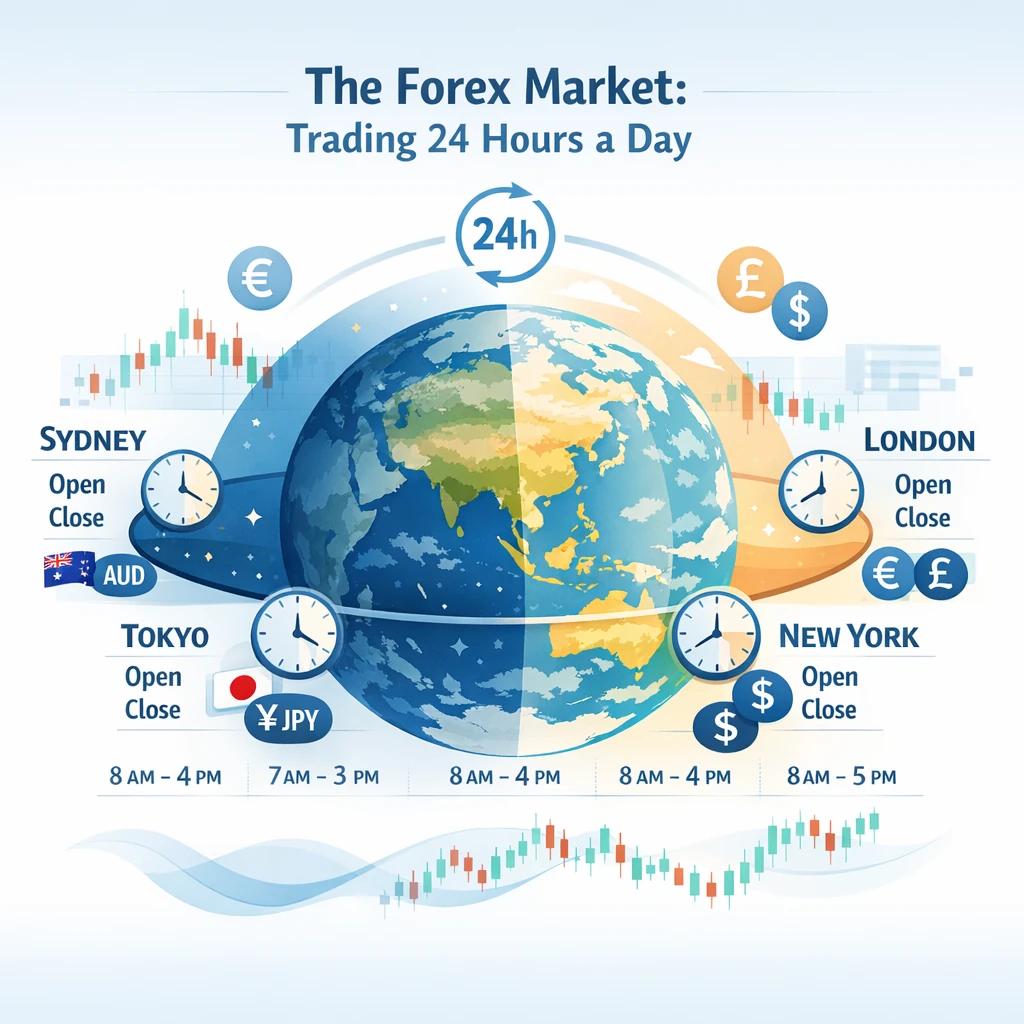
For the purpose of analysis and educational study, the market day is divided into four major sessions:
- The Sydney Session (Pacific)
- The Tokyo Session (Asian)
- The London Session (European)
- The New York Session (North American)
Let's explore the characteristics, specific hours, and learning opportunities within each of these sessions.
When analysts discuss Forex market hours, they are usually referring to the operating hours of these four major economic centers. It is important to note that opening and closing times are not exact to the second, as they reflect the general business hours of banks in those regions.
- Approximate Open: 9:00 PM GMT (Winter) / 10:00 PM GMT (Summer)
-
Approximate Close: 6:00 AM GMT (Winter) / 7:00 AM GMT (Summer)
The market week officially kicks off in the Pacific. While often grouped with the Asian session, the Sydney session has distinct characteristics. It starts when the markets open in Wellington, New Zealand, followed shortly by Sydney, Australia.
Characteristics: The Pacific session is generally the quietest of the major sessions. Liquidity is lower compared to the London or New York sessions, which means price movements can be smaller. However, lower liquidity can sometimes lead to "gaps" in price if significant news occurred over the weekend.
What to Watch: This is the prime time for observing the Australian Dollar (AUD) and the New Zealand Dollar (NZD). If you are studying pairs like AUD/USD or NZD/USD, you might see initial reactions to economic data released from these countries during this time.
- Approximate Open: 11:00 PM GMT (Winter) / 12:00 AM GMT (Summer)
- Approximate Close: 8:00 AM GMT (Winter) / 9:00 AM GMT (Summer)
As the Sydney session gets underway, the Tokyo session comes online. Japan is the third-largest market center in the world, and the Japanese Yen (JPY) is the third most traded currency. This session represents the bulk of Asian market activity, with Hong Kong and Singapore also joining the fray.
Characteristics: The Asian session is known for consolidation. Prices often move within a tight range, which can be a key lesson for those learning about range-bound markets. The volatility is generally lower than in the upcoming European session. However, major news releases from the Bank of Japan or data regarding Japanese manufacturing can cause sharp spikes in JPY pairs.
What to Watch: The USD/JPY pairing is a major focus of this session. Students also monitor crosses like AUD/JPY and EUR/JPY. Because Japan is a major exporter, the movements here can sometimes set the tone for the rest of the market day, providing valuable context for study.
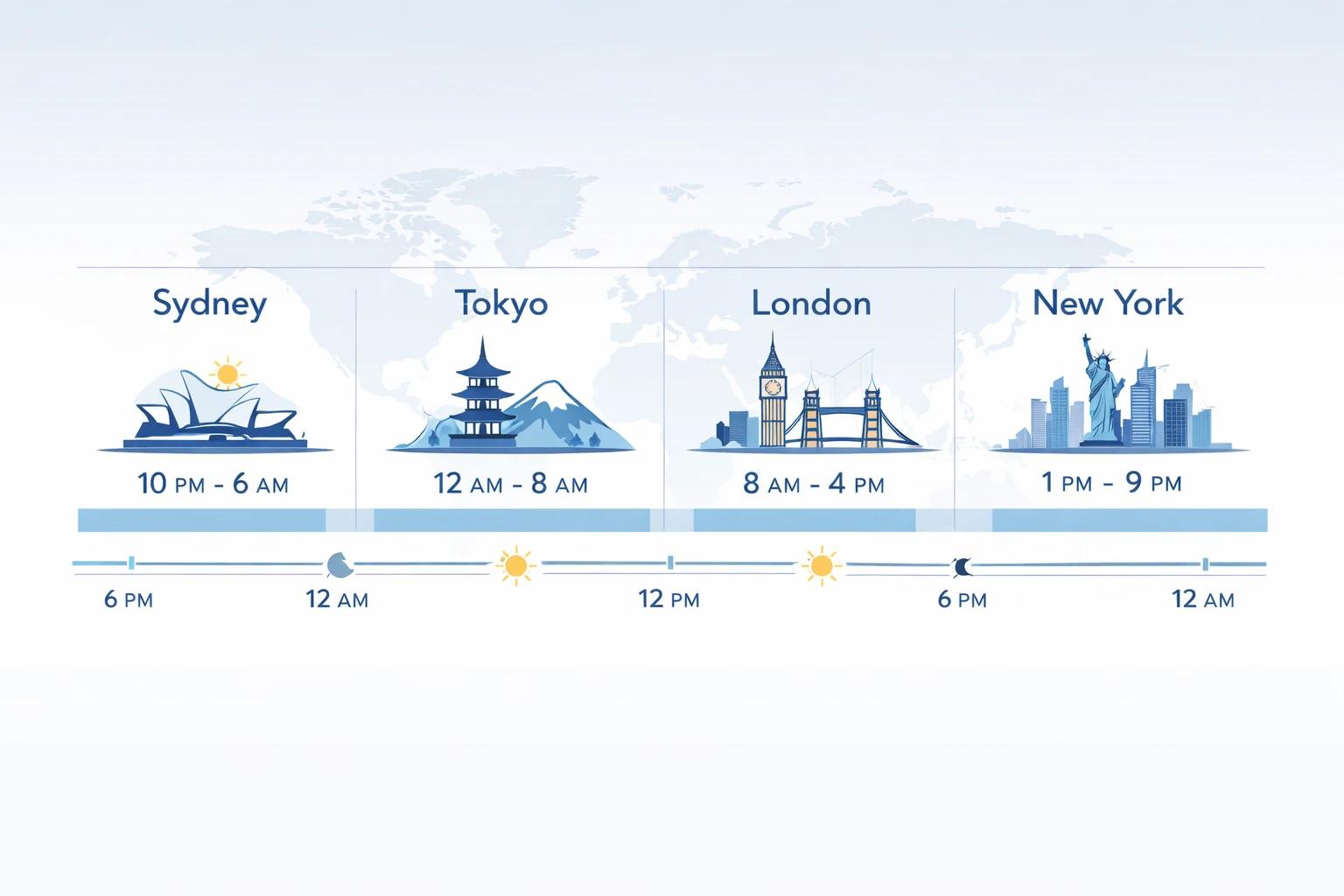
- Approximate Open: 7:00 AM GMT (Winter) / 8:00 AM GMT (Summer)
-
Approximate Close: 4:00 PM GMT (Winter) / 5:00 PM GMT (Summer)
The London session marks the true beginning of high-volume market activity. London has historically been the financial capital of the world, and it remains the central hub for Forex transactions. Approximately 43% of all global Forex transactions happen during this time.
Characteristics: This is when the market wakes up. Volatility increases significantly as major European banks and hedge funds begin their day. Trends that began in the Asian session may reverse, or new trends may be established that last until the New York close. Because of the massive volume of transactions, spreads (the difference between the buy and sell price) tend to tighten, making it a common period for market observation.
What to Watch: The European market session is ideal for studying the "Majors" (EUR/USD, GBP/USD, USD/CHF). The British Pound (GBP) and the Euro (EUR) are most active here. If you are looking to understand market movement and trend development, the London session is often considered a prime time for market analysis.
- Approximate Open: 12:00 PM GMT (Winter) / 1:00 PM GMT (Summer)
-
Approximate Close: 9:00 PM GMT (Winter) / 10:00 PM GMT (Summer)
The North American session begins as the European traders are returning from their lunch breaks. Dominated by the U.S. financial markets, this session is heavily influenced by Wall Street, the Federal Reserve, and American economic data.
Characteristics: The U.S. Dollar is involved in roughly 85% of all Forex trades. Consequently, when New York opens, liquidity remains very high. The early part of this session is volatile and fast-paced. However, as the afternoon progresses and European traders go home, volatility tends to die down, leading to a quiet close before the cycle restarts in Sydney.
What to Watch: Virtually any pair involving the USD is active. This is also when vital economic reports, such as Non-Farm Payrolls (NFP) or GDP figures, are released, usually around 8:30 AM EST (1:30 PM GMT). These reports can cause massive immediate price fluctuations, offering critical lessons in market reaction.
While understanding the individual sessions is useful, the "secret sauce" of Forex scheduling lies in the Forex market overlaps. An overlap occurs when two major financial centers are open simultaneously. During these windows, the number of market participants effectively doubles, creating the highest liquidity and volatility of the day.
For beginners wondering about periods of high volatility or liquidity, these overlaps are the answer.
- Time: Approx. 1:00 PM GMT to 5:00 PM GMT
This is the heavyweight champion of market activity hours. For a period of about four hours, the world's two largest financial centers—London and New York—are both active.
Why is this important for study?- Maximum Liquidity: With European and American banks active simultaneously, it is easy to observe efficient price discovery.
- High Volatility: The biggest trends often make their major moves during this window, providing clear examples of momentum.
- Tightest Spreads: Due to the intense competition and volume, spreads tend to be narrowest during this overlap, a key point for learners to note.
If you have limited time and want to observe the most significant market moves, the London and New York overlap period is a key window for focused study.
Forex market overlaps showing high liquidity periods
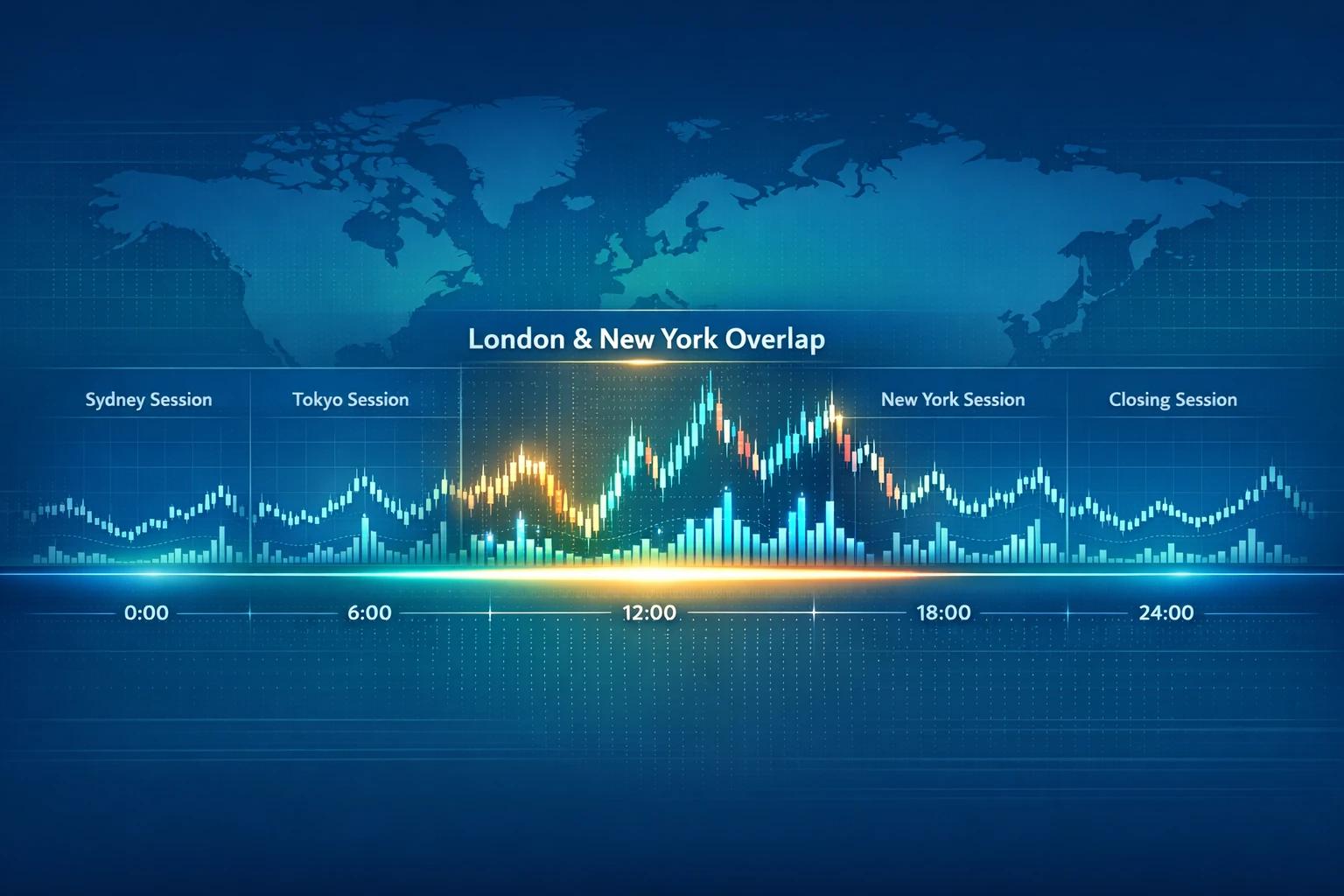
- Time: Approx. 8:00 AM GMT to 9:00 AM GMT
This overlap is much briefer and generally less explosive than the US/Europe crossover. It occurs as the Asian markets are winding down and London is just ramping up. You may see the European market reacting to overnight moves in Asia, or Asian traders adjusting their positions before closing for the day. It can be a complex period to analyze due to the "changing of the guard," where trends can sometimes reverse abruptly.
One of the most confusing aspects for beginners is converting these global hours into their local time. You might see a study guide referencing "10:00 AM EST" while your platform's chart displays time in GMT or UTC.
To avoid confusion, professional analysts often use Forex market hours GMT (Greenwich Mean Time) or Forex market hours UTC (Coordinated Universal Time) as the standard reference. Since the Forex market is global, having a single "anchor" time zone helps students coordinate regardless of whether they are in Tokyo, Berlin, or San Francisco.
The market hours listed in this guide are subject to shifts due to Daylight Saving Time. This can be a headache because different countries change their clocks on different dates.
- The United States usually shifts clocks forward in March and back in November.
- The United Kingdom/Europe usually shifts clocks late in March and late in October.
- Japan does not observe Daylight Saving Time.
- Australia observes it during the Southern Hemisphere summer (Northern Hemisphere winter).
During the weeks where the US has changed clocks but the UK hasn't (or vice versa), the London and New York overlap time shifts by one hour. This period requires extra vigilance. It is highly recommended to use a Forex time zone converter or a market hours monitor app during these transition weeks to ensure you are observing the markets at the correct time.
Is
there objectively a "best" time to trade? The honest answer is: it
depends on your strategy and the currency pairs you prefer.
If you are looking to understand fast price action and market dynamics (including associated risks), the
London session and specifically the
London/New York overlap offer a prime case study.
- Common Pairs to Observe: EUR/USD, GBP/USD, USD/JPY
- Why: These hours provide significant price movement that is essential for learning how volatility and liquidity interact.
If your educational focus is on prices bouncing between support and resistance levels, the
Asian session (
Tokyo) might be your best reference point.
- Common Pairs to Observe: AUD/JPY, USD/JPY, EUR/CHF
- Why: The lower volatility creates more predictable, oscillating movements, which are useful for studying specific technical concepts.
If you have a full-time job in the US or Europe, the Sydney session or the early Asian session offers a chance to study in a calmer environment during your evening hours. While the moves are smaller, the market is still open and observable.
Part of being a diligent learner of market mechanics is knowing when conditions are less ideal for clear analysis.
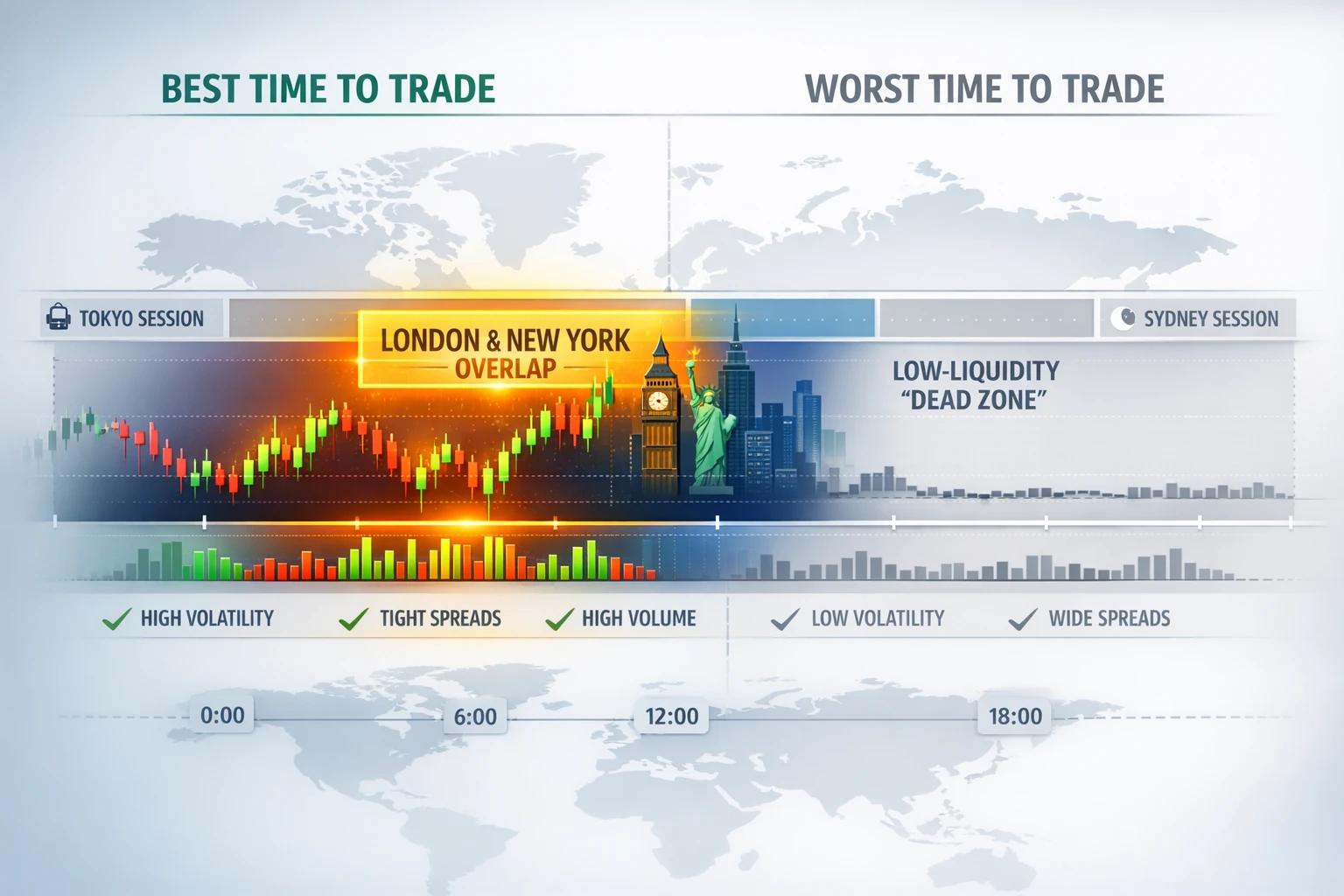
Between the close of the New York session (approx. 5:00 PM EST) and the opening of the Tokyo/Sydney liquidity (approx. 7:00 PM EST), spreads often widen drastically. Liquidity is at its absolute lowest point of the 24-hour cycle. Analyzing here can be challenging because a small amount of volume can cause erratic price movements.
You must be aware of the Bank holidays market schedule. Since Forex is an OTC market run by banks, if the banks in London are closed for a Bank Holiday, liquidity for GBP pairs will drop significantly.
• Christmas Forex market hours: The weeks surrounding Christmas and New Year are notoriously quiet. Most institutional participants are on vacation, leading to "thin" markets. Thin markets can result in unpredictable spikes or virtually zero movement for hours.
• Advice for Learners: Many experienced analysts reduce their market observation entirely from mid-December until the second week of January due to these atypical conditions.
The retail Forex market is closed on weekends. However, news events (political elections, natural disasters) continue to happen. This leads to "gaps" at the Sunday open. This is an important concept to understand regarding market behavior.
You do not need to memorize these times or manually calculate time zone differences every day. There are excellent tools available to help you visualize the market.
- World Clock for Forex Learners: Many Forex websites offer a dashboard displaying the current time in Sydney, Tokyo, London, and New York simultaneously.
- Forex Market Time Map: These visual tools show a map of the world with "lit up" regions indicating which sessions are currently active.
- Market Session Indicator MT4: If you use MetaTrader 4 or 5, you can download simple plugins that overlay colored boxes on your charts. These boxes visually indicate the Asian, London, and NY sessions directly behind your price candles. This is incredibly helpful for educational review of how price acts during specific times.
- Forex Market Hours PDF: For beginners, printing a cheat sheet or PDF schedule converted to your local time zone and sticking it to your wall is a great low-tech solution.
It is helpful to contrast Forex with the stock market to appreciate the difference in flow.
- The Stock Market: Operates on a rigid schedule (e.g., NYSE is 9:30 AM to 4:00 PM EST). If bad news breaks after 4:00 PM, you generally cannot react until the next morning, often resulting in a massive "gap" down.
- The Forex Market: Because it is a 24/5 continuous loop, if news breaks at 3:00 AM, the market can react instantly. There is almost always a market open somewhere.
However, the stock market has one pedagogical advantage: the limited hours concentrate liquidity. In Forex, liquidity is spread out, which is why identifying periods of high liquidity (overlaps) is so critical for understanding different market environments.
To give you a deeper understanding, let's look closer at the specific dynamics of the regional sessions.
While smaller, this session is vital for understanding concepts like the "carry trade" setup. This involves investors borrowing low-interest-rate currencies (like the JPY in the past) to buy high-interest-rate currencies (often AUD or NZD). The activity here can signal the sentiment for the rest of the day, providing an early lesson in market sentiment.
Japan is an export powerhouse. This means huge amounts of currency are exchanged by corporations (like Toyota or Sony) to repatriate profits. These commercial transactions, rather than just speculation, drive much of the volume here, a key point of fundamental analysis. Furthermore, China is a major player. Although the Yuan is tightly controlled, data from China (released during this session) impacts the Australian Dollar significantly because China is Australia's largest trading partner, showing intermarket relationships.
London is the banking capital. The "London Fix" is a specific time (4:00 PM London time) when daily currency rates are set for huge commercial contracts. In the minutes leading up to the London Fix, significant price swings can occur as banks balance their books. Students of the market watch this window carefully to learn about institutional flows. Also, because the European session overlaps with the end of Asia and the start of the US, it is the bridge that connects the global economy.
The USD is the world's reserve currency. Commodities like Gold and Oil are priced in USD. Therefore, the New York session isn't just about currency pairs; it's about the interplay between Forex and commodities, offering a broader lesson in macroeconomics. If the US stock market experiences significant movement during this session, it often causes instant ripples in Forex prices, demonstrating market correlations.
At Pipdemy, we want you to learn safely. Here is a summary checklist regarding market hours:
- Know Your Local Conversion: Do not guess. Use a Forex time zone converter to know exactly when London opens in your local time.
- Focus Your Analysis on the Overlap: For a beginner student of the markets, the London/NY overlap offers a clear view of "efficient" price movement (high volume means it is harder for the market to be manipulated), making it an excellent period for educational observation.
- Beware the Sunday Open: Spreads are often huge when the market first opens in Sydney/Wellington on Monday morning (Sunday night in the West). It's educational to wait a few hours for liquidity to normalize to see the difference.
- Respect the Holidays: If it is Thanksgiving in the US, the New York session will be quiet. If it is a Bank Holiday in the UK, the London session will be quiet. Use a market hours monitor regularly to plan your study sessions effectively.