Forex simulated learning environments are often the first interactive experience new learners have with
currency markets. It looks simple: access a simulated environment, observe market mechanics with virtual values, and learn as you go. In practice, simulation is far more than clicking buttons. Used well, it becomes a structured educational sandbox where knowledge, analytical habits, and market understanding are built step by step. Used poorly, it becomes unstructured screen time that teaches little and can create misunderstandings.
At Pipdemy, simulation is not treated as a shortcut. It is treated as a core educational module with a clear purpose. The goal of this article is to explain how market simulations actually work, why they matter for building financial literacy, and how they fit into a modern learning approach that combines Forex education, experimentation, and AI-supported analysis. You will learn what a market simulator really is, what it should be used for, and how to approach it with a structured mindset.
This guide focuses on clarity and educational value. Forex markets involve complexity and volatility and require patient study. A simulated environment does not remove these realities, but it gives learners a practical space to observe and understand them without financial stakes.
To learn effectively, it's important to start with a clear definition.
A market simulator (simulated learning environment) is a practical educational tool that mirrors live market conditions using real-time price data, but operates with virtual value. Simulated order processing, spreads, and price movements behave according to market logic, allowing observation of cause and effect, but all outcomes remain conceptual learning exercises.
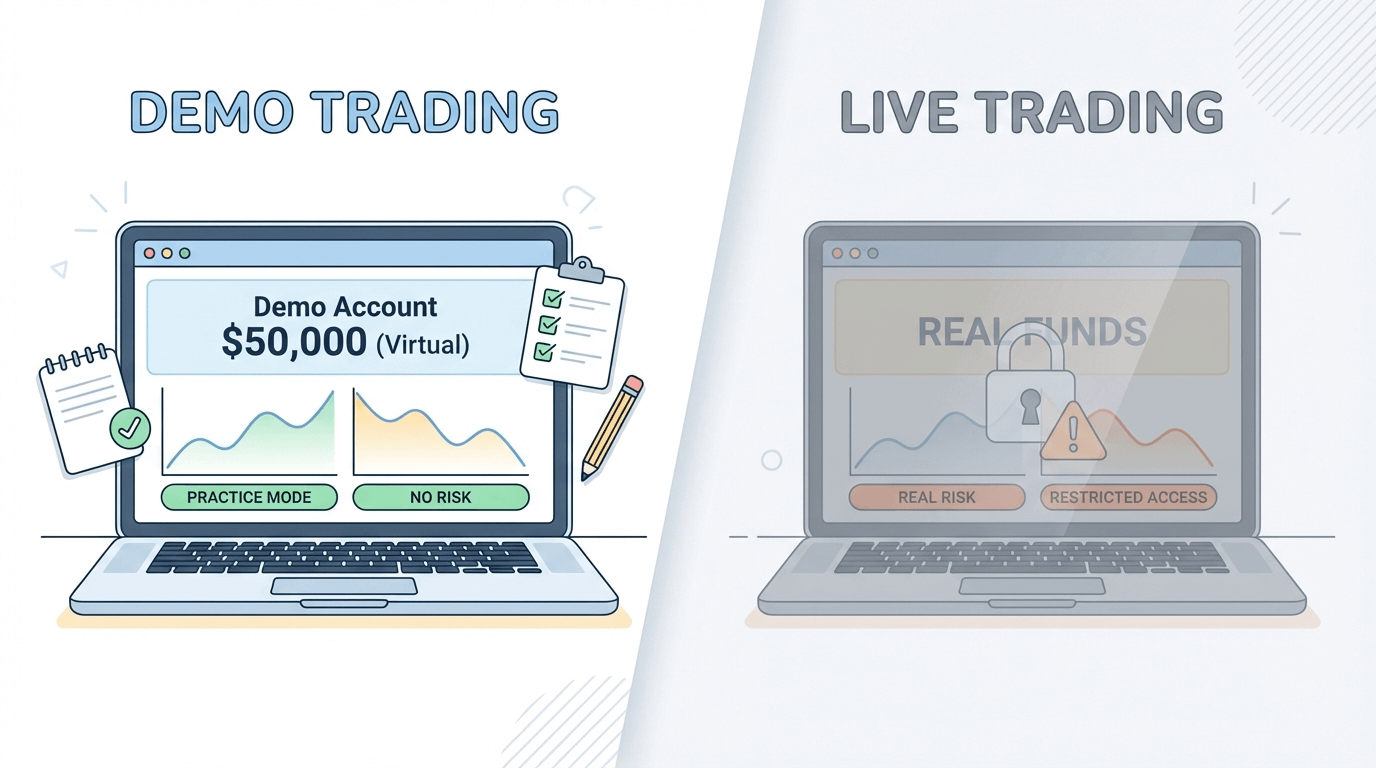
A Forex market simulator exists to help learners observe how markets function, not to measure hypothetical outcomes. Its core educational purposes include:
-
Learning how a platform's interface and tools work.
-
Understanding different order types and how they are processed by market logic.
-
Observing how prices move during different market sessions and news events.
-
Studying how risk management principles are applied in a dynamic environment.
-
Testing analytical ideas in a controlled, consequence-free setting.
The simulator is a learning and observation tool. When users focus only on the virtual balance, they often miss the deeper lessons about market behavior and their own analytical process.
A market simulator has clear educational boundaries. Its primary limitation is that it cannot fully replicate the psychological weight of real-world consequences. This does not diminish its value; it simply defines its role within a learning journey.
A simulator does not:
-
Guarantee or predict future theoretical or actual outcomes.
-
Automatically build emotional discipline (though it can build discipline in following a study plan).
-
Serve as a direct substitute for the complexity of real-world decision-making.
-
Understanding these limits helps learners use the tool with accurate expectations and goals.
Many beginners rush through the simulated phase or underestimate its value.
Building Knowledge Before Advanced Concepts
In most fields of study, foundational practice precedes advanced application. Market education is no different. The simulator is where essential analytical competencies should be formed, including:
-
Following a predefined study or observation plan.
-
Applying consistent virtual allocation logic.
-
Practicing patience in waiting for specific market scenarios to analyze.
-
Objectively reviewing outcomes without emotional attachment.
When these concepts are not solidified early, they are much harder to internalize later when studying more complex market theories.Unstructured use of a simulator teaches very little. Structured use, however, creates measurable progress in understanding. Treating it as deliberate practice shifts the focus from a virtual outcome to the learning process itself. This mindset is essential for developing consistency in analysis.
At Pipdemy, the market simulator is framed as intentional, goal-oriented practice. Every session should have a learning objective, and every observed scenario should have a rationale.

The key to effective learning lies in the user's approach, not the tool itself.
Simulators often default to large virtual balances. While this can be engaging, it may create distorted perspectives. A better educational approach is to use parameters that reflect a focus on percentages and logical allocation, encouraging:
-
Consistent virtual allocation relative to the virtual balance.
-
Respect for the concept of outcome variance in an analytical framework.
-
Realistic expectations about the rate of growth in market knowledge.
The easiest way to dilute the educational value is to treat the simulator as a game. Taking random actions, ignoring predefined rules, or analyzing outcomes without logic reduces its effectiveness as a learning tool.
A productive approach includes:
-
Defining a maximum virtual observation size per observed scenario.
-
Applying clear, rules-based criteria for "entering" an observation.
-
Avoiding impulsive or repetitive actions that lack an analytical basis.
By engaging seriously with the simulator, learners build disciplined habits of thought that are valuable for all further financial education.
A common topic of study is the psychological difference between simulated and real-stakes environments. While the emotional intensity differs, the goal is for the core analytical behaviors to be consistent.
In a simulator, outcomes carry no financial consequence. This reduces the fear of loss and allows for more freedom in observation and hypothesis testing. For some, this leads to clearer thinking. For others, it can reduce the sense of consequence. Neither reaction is inherently bad, but both are important to recognize for self-awareness.
Despite its limits, a simulator is excellent for teaching foundational disciplinary skills:
-
Patience: Learning to wait for a specific setup to appear before acting.
-
Consistency: Practicing the repetition of following a set of analytical rules.
-
Objective Review: Developing the habit of reviewing outcomes based on data and adherence to plan, not emotion.
These traits create a strong foundation for any complex field of study.
Without structure, simulator use becomes sporadic and less effective. Strong practice routines create a framework for steady improvement.
Effective practice does not require marathon sessions. It requires focus. A simple session might include:
-
Reviewing current market conditions as an exercise.
-
Defining one specific market scenario or pattern to look for.
-
"Executing" an observation only if the predefined rules are met.
-
Concluding after a set number of observations or a time limit.
This approach reduces noise and improves the quality of attention and analysis.
Beginners often believe that complexity equals progress. In education, depth of understanding often comes from repetition. Practicing the analysis of one or two market scenarios consistently produces clearer insights than constantly jumping between new, unmastered ideas. At this stage, learning how price behaves in certain conditions matters more than accumulating countless untested ideas.
Recognizing common pitfalls early saves time and enhances the learning curve.
A small series of favorable outcomes can create a false sense of mastery. Simulated conditions, where variance plays a role, make this especially likely. It's crucial to remember that meaningful insight in market study comes from observing large samples of data, not short-term luck.
The habit of breaking predefined analytical rules in a simulator directly trains the mind to break them in any setting. The environment does not change the habit of discipline being formed. The goal is to build consistent analytical muscles.

One of the most important habits a learner can build early is journaling within the simulator. Many believe journaling only matters later, but in reality, simulator journaling is where this critical habit is formed.
Human memory, especially regarding decision-making patterns, is unreliable. We tend to recall what confirms our beliefs. A journal creates an objective, searchable record of your analytical process.
In the simulator, journaling helps you:
-
Identify repeated logical errors or biases.
-
Understand which parts of your plan are hardest to follow.
-
Objectively separate lucky outcomes from skillful analysis.
-
Track the evolution of your understanding over time.
Without a journal, simulator work can feel active but not cumulative in its learning.
A useful journal doesn't need to be complex. Consistency is key. Valuable elements include:
-
Date, time, and market instrument observed.
-
The analytical reason for the observation (e.g., "Testing reaction to support level X").
-
The planned observation conclusion points and the rationale for them.
-
The actual outcome and reason for closing the observation.
Notes on your focus and any deviations from the plan.
The goal is not self-criticism, but creating visibility. Patterns in your thinking become clear only when they are documented.
One of the most powerful uses of a market simulator is safely testing analytical frameworks and hypotheses.
Many say they are "testing a strategy," but are merely observing randomly. Real testing starts with a clear, falsifiable hypothesis.
A testable analytical framework should answer:
-
What specific market condition am I looking for? (Entry Hypothesis)
-
At what point is my initial logic invalidated? (Invalidation Point)
-
What is my theoretical objective based on the structure? (Theoretical Objective)
-
What percentage of my virtual balance is allocated to this single observation? (Allocation Logic)
With clear rules, the simulator becomes a structured laboratory, not a guessing game.
Testing a hypothesis over five observations proves nothing. Markets have randomness. To learn, you need a sufficiently large sample size to observe statistical tendencies.
As a general guideline for learning:
-
20–30 observations may show initial behavioral tendencies.
-
50+ observations are needed to start assessing the consistency of the logic.
Larger sample sizes reduce the emotional impact of any single outcome and lead to more robust conclusions. This methodical approach is perfectly aligned with data-driven learning and tools like AI-assisted review, which rely on clean, structured data for meaningful feedback.
A common mistake is constant tweaking. Learners change rules after every unfavorable outcome, trying to "perfect" the hypothesis in real-time. This prevents true learning, as it doesn't allow you to see how an idea performs through various market cycles.
Simulator testing should focus on gathering data and understanding the behavior of a system, not on engineering a perfect short-term result. Flaws and outcome fluctuations are critical information, not failure.
Strong routines make simulator practice a regular, productive part of your education.
A simple yet effective daily routine could be:
-
Brief Market Review: Scan major charts to understand the current context (trending, ranging, volatile).
-
Define the Day's Learning Goal: "Today, I will only observe scenarios where price retraces to a moving average in a trend."
-
Execute with Discipline: Observe only if your predefined criteria are met.
-
Stop and Review: Conclude after 2-3 high-quality observations or a set time limit. Log them immediately.
This routine eliminates impulsive behavior and decision fatigue.
Learning compounds through reflection. Once a week, review your journal to ask:
-
Did I follow my own rules? Where did I deviate and why?
-
What were the common factors in my most insightful observations? In my least insightful ones?
-
What is one specific aspect of market behavior I understand better now than I did last week?
Observing alone does not create growth; structured reflection on your observations does.
Signs You Are Consolidating Your Understanding.
The goal of the simulator phase is to build a robust foundation. You know you are progressing when:
-
Your rules are followed consistently, not situationally.
-
Your virtual observation size per observation is stable and predefined.
- You can review a week of outcomes without emotional highs or lows.
Your journal shows improvement in the clarity of your analysis, not just in virtual results.
If these are not yet stable, more time in the simulator is not wasted—it's a necessary and valuable phase of your education.
The simulator should not be seen as a phase you simply "graduate" from and abandon. It remains a vital tool for continuous learning.
Even as your knowledge advances, the simulator is invaluable for:
-
Safely studying a new market instrument or asset class.
-
Practicing analysis under new or unusual market conditions (e.g., high volatility).
-
Re-building confidence in your analytical process after a period of distraction.
-
Testing adjustments to a framework without any consequence.
Using the simulator in this way protects the depth of your learning and encourages continuous experimentation.
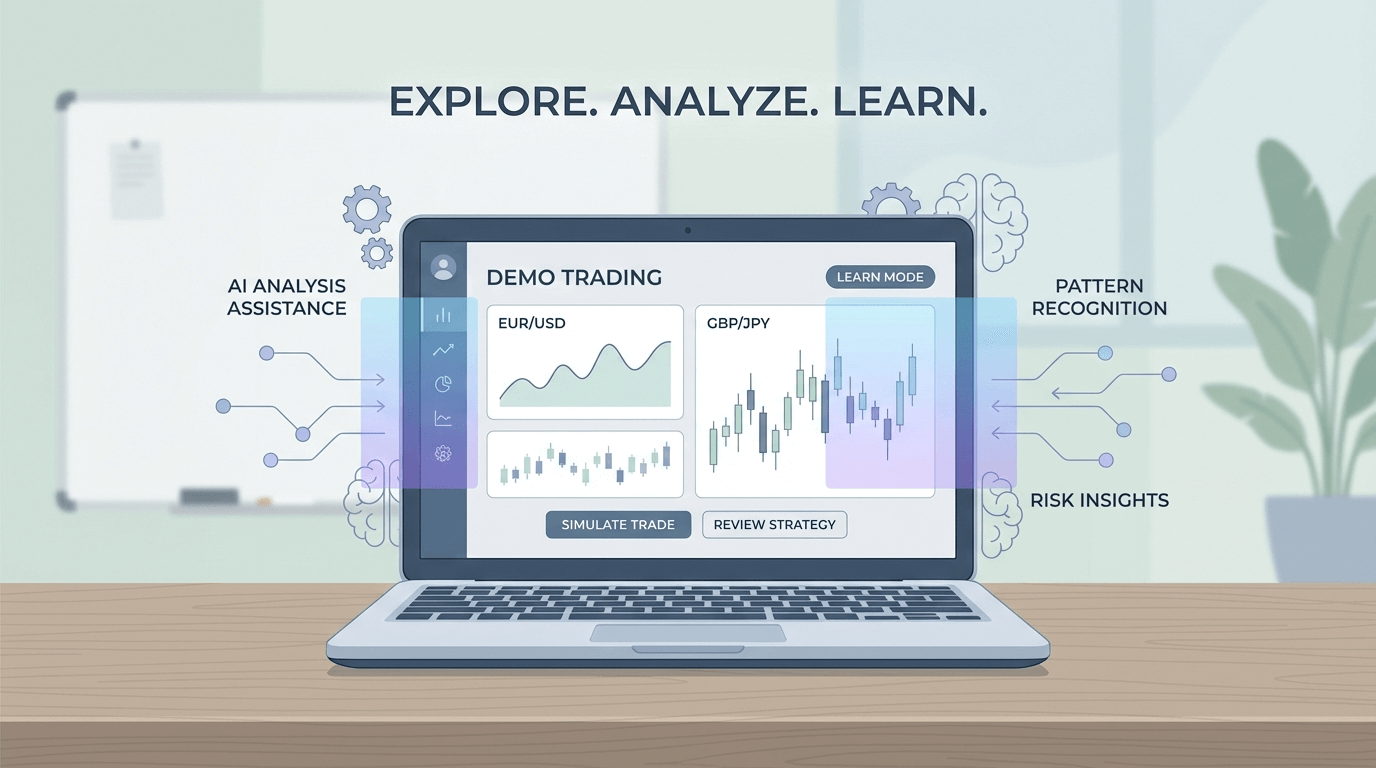
Modern financial education increasingly incorporates AI and data analytics. These tools can help identify patterns in your behavior, review the statistical properties of your hypotheses, and provide personalized feedback. However, their effectiveness is built on a foundation of clean, structured data.
AI-driven educational tools work best when:- Your observations follow consistent, documented rules.
- Your virtual allocation is controlled and logical.
- Your journaling is precise and complete.
A disciplined approach to the simulator provides this high-quality data. Random or emotionally-driven simulator use creates "noisy" data that limits the usefulness of any analytical tool, human or AI.
When you treat the simulator as an experimental framework, you naturally start thinking in terms of probabilities and scenarios instead of certainties. You stop asking, "Will this work?" and start asking, "Under what specific conditions has this logic held, and when has it failed?"
This probabilistic, evidence-based mindset is the cornerstone of sophisticated financial analysis and lifelong learning.
An honest conclusion is necessary. A Forex market simulator does not guarantee any specific educational or future outcome. It does not remove the challenges of mastering a complex subject, and it does not make you an expert.
What it does provide is:
-
A safe, practical environment to make and learn from mistakes in analysis.
-
The time and space to build disciplinary and analytical habits.
-
Hands-on experience with market mechanics without financial risk.
The essential foundation upon which all more advanced financial education is built.
Learners who respect the simulator phase as serious study tend to develop a deeper, more resilient understanding of markets. Those who rush through it often find themselves needing to relearn the same fundamental lessons later, potentially with less patience. The simulator is your classroom, use it to build knowledge that lasts